The 2026 BEHAVIOR Challenge doubled in size to 100 household tasks. Our modified π0.5 policy won last year’s challenge. This year, we extended it into one learned policy for all tasks. Key changes were aligning stages with skill annotations, matching actions to teleoperation controls, excluding demonstration frames after task success, and lowering training variance.
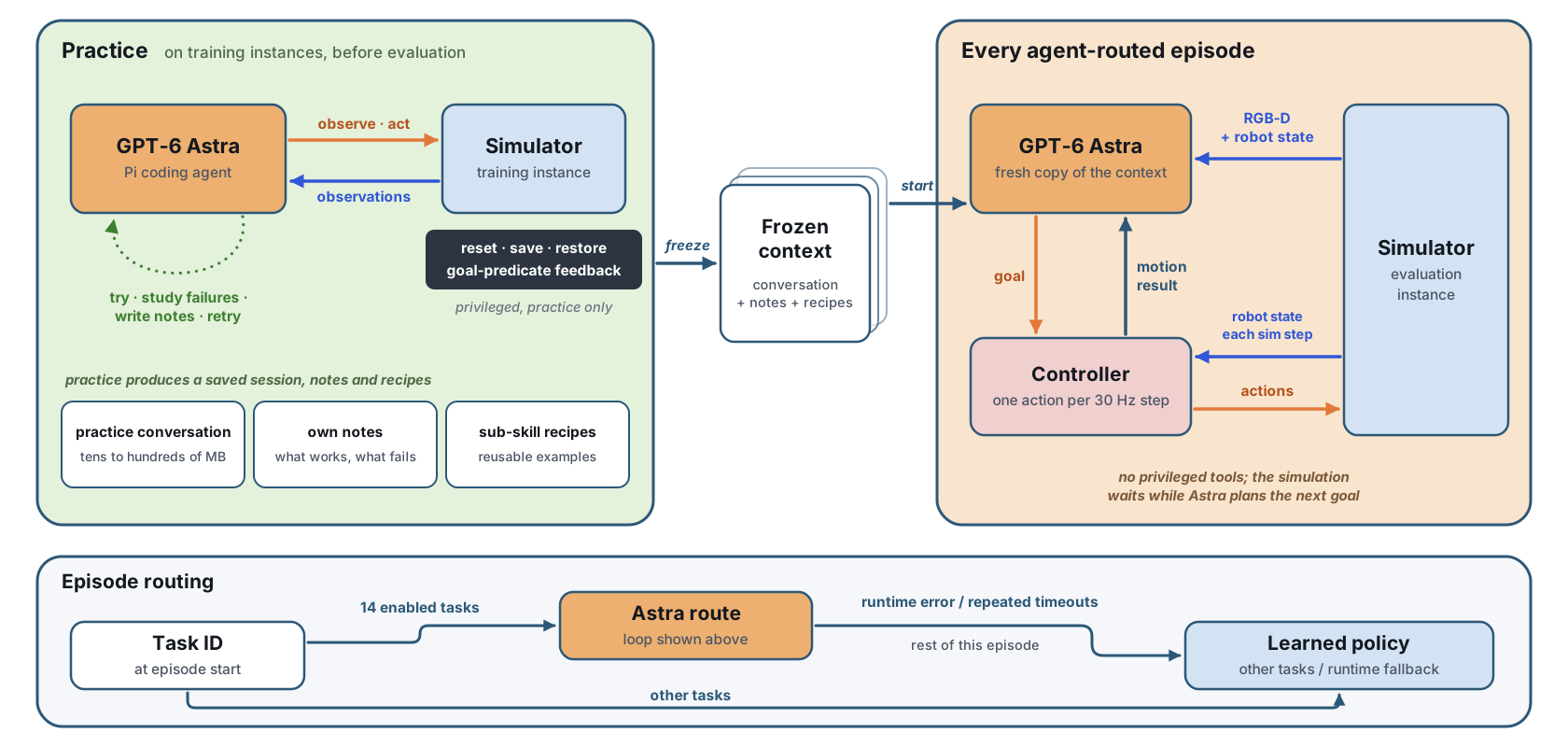
We also developed an agentic approach: a GPT-6 Astra agent that controls the robot through observation and motion tools, starting each evaluation from a frozen copy of its practice on training instances.
Challenge
Training Examples
Each task comes with 200 demonstrations recorded via teleoperation. Video: robot head camera 8× speed.
The Challenge includes 100 tasks set in multiple house-like environments. The main difficulties are:
- Long-horizon execution: Human demonstrations average 5.9 minutes; evaluation allows up to 1.5× each task’s mean human duration.
- Bimanual manipulation: Coordinated control of two 7-DOF arms with parallel jaw grippers.
- Mobile navigation: Operation in realistic indoor and outdoor environments.
- Non-Markovian states: Many states are visually ambiguous. Without memory of past actions or explicit stage tracking, the policy cannot distinguish between these states and may take incorrect actions.
- No recovery demonstrations: The training set contains only successful demonstrations, spanning a very narrow manifold of possible trajectories.
- Data: Each task provides 200 demonstrations. Public evaluation uses 10 additional instances per task.
- High compute requirements: Training on all 1,950 hours of data takes weeks, and full evaluation across all 100 tasks takes several days.
Method
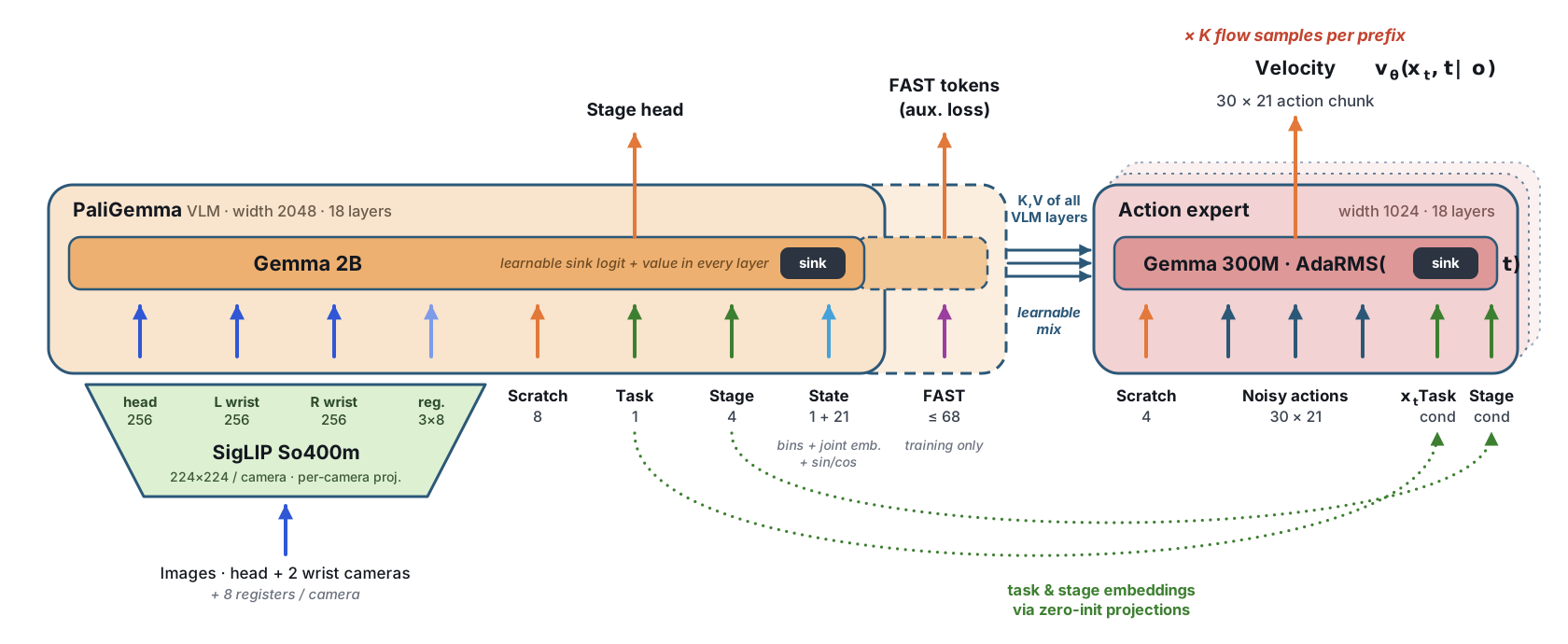
We extended our 2025 π0.5 policy into one checkpoint for all 100 tasks. We aligned stages with demonstration skill annotations, initialized embeddings for new tasks from similar old ones, matched actions to teleoperation controls, and trained longer with lower-variance flow matching. For tasks where the learned policy struggled, we tried an agentic approach with GPT-6 Astra. The agent controls the robot through observation and motion tools, practices on training instances, studies failures, and starts evaluation from a frozen copy of its practice session.
VLA (modified π0.5)
Agentic (GPT-6 Astra)
Results
| Rank | Team | Affiliation | Method | Q Score | Full-task SR |
|---|---|---|---|---|---|
| 1 | The North Star | Huawei Noah EAI Team | Hiearchical Physical RSI | 0.683 Verified | 48.2% Verified |
| 2 | IF1001 | Intellifusion | VLA WAM | 0.615 Verified | 41.2% Verified |
| 3 | Cyber | Xiaomi Robotics | WAM | 0.596 Verified | 39.6% Verified |
| 4 | Anyverse | Anyverse-Autolab | A²MEAS | 0.498 Verified | 32.0% Verified |
| 5 | Autolab | Anyverse-Autolab | A²WLA | 0.495 Verified | 30.9% Verified |
| 6 | XYRobot | Beijing XY Robot Technology Co., Ltd. | VLA+RSI | 0.484 Verified | 28.9% Verified |
| 7 | asteroid | CLab | Agent + WAM | 0.514 Self-reported | 30.8% Self-reported |
| 8 | Tasman3001 | Ambarella, Inc. | VLA+RSI | 0.481 Self-reported | 30.4% Self-reported |
| 9 | Robot Learning Collective | Independent | Modified PI0.5 and Astra | 0.446 Self-reported | 27.3% Self-reported |
| 10 | VGI-SKT | SNU / SKT | VLA | 0.445 Self-reported | 22.3% Self-reported |
| … | |||||
Learned policy (π0.5)
Results by task
Loading task results…
Failure analysis
We manually labeled failures on ten tasks and compared the reasons with last year’s results.
- Order: Sequencing errors dropped most. We now cut demonstrations at task success, excluding the post-success frames used in 2025 training. Better aligned semantic stages may also have helped, though we did not isolate their effect.
- Robot fell and stuck: Both became less common. Our action representation now matches the teleoperation controls and prevents torso configurations absent from the demonstrations. We observed fewer falls during deep squats; the same change may explain fewer stuck episodes.
- Dexterity: Its labels remained high, but rollout reviews showed better recovery from manipulation failures. With fewer early sequencing and stability failures, more episodes reach difficult manipulation steps, making dexterity limitations more visible.
Emergent behavior
Though trained only on successful demonstrations, the 2026 policy often recovers from mistakes and continues the task. Compared with last year, it attempts recovery more readily and adapts familiar actions to new situations, sometimes switching arms or changing the action sequence.
Struggles to pick up a beetroot.
Places the bin prematurely, then approaches with the can.
Agentic approach (GPT-6 Astra)
Near the competition deadline, we saw Astra begin solving simulated robotics benchmarks (crucially, without a wall-time limit). We tried it on failures of our learned policy and found that it could recover from most of those we tested. We considered using it for online recovery, distilling its behavior into the policy, or as a System 2 controller. With time and budget running out, we chose direct control.
We routed 14 tasks where the learned policy struggled and Astra showed promise; time and API costs limited further practice and evaluation. On those tasks, Astra reached a mean Q of 0.639, compared with 0.108 for the learned policy.
π0.5 reaches the fridge and opens it faster than Astra.
Inside an Astra rollout
Step through the recorded model, tool, and robot actions. Times include model and tool waits.
Team
- Ilia Larchenko: learned policy, overall setup and training.
- Gleb Zarin: learned policy and evaluation infrastructure.
- Atindra Nair: agentic control logic.
- Keerti Manney: evaluation infrastructure and agentic experiments.
- Vitaly Kleban: fundraising and model training.
- Anjana Yodaiken: hardware teleoperation device.
- Mirko Kiefer: model experiments and evaluations.